

About the Journal
This is the official journal of the research centre Digital, Technologies, Education & Society of Link Campus University. It explores the complex relationships between information and communication technologies and the entire educational system, conceived as a single macro-system education-training-university-work-transition process.
The Community Notebook is oriented to the study and understanding of the cultural, social, organizational and educational complexity of our time ... read more
Current Issue
WORKSHOP PROCEEDINGS - Universities Driving Social Innovation: Empowerment and Youth Leadership in Territorial Ecosystems
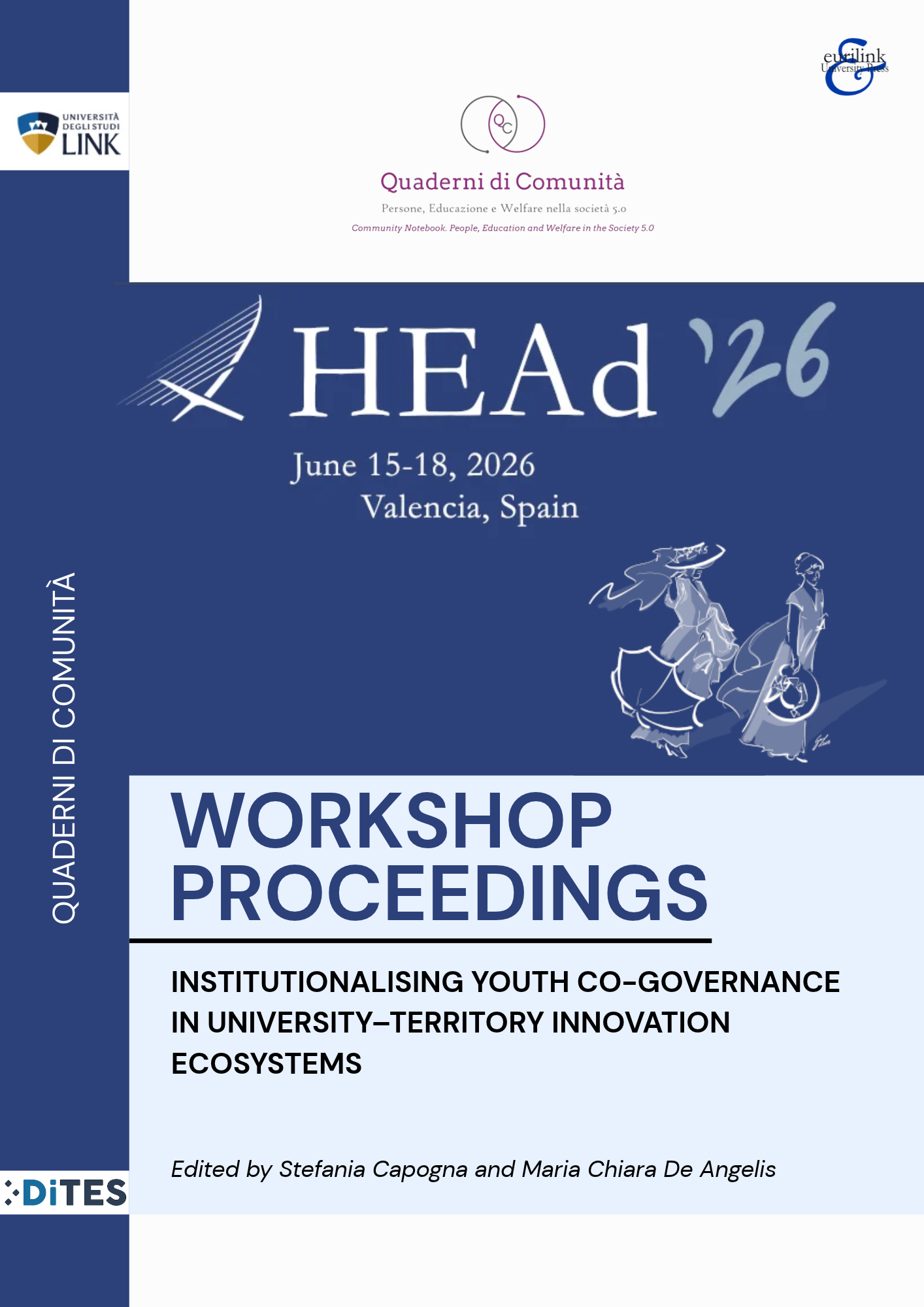
Edited by Stefania Capogna and Maria Chiara De Angelis
This special issue, “Universities Driving Social Innovation: Empowerment and Youth Leadership in Territorial Ecosystems”, promotes interdisciplinary discussion of institutionalising youth co-governance models within higher education institutions and their territorial networks.
It features the proceedings from the Workshop, "Institutionalising Youth Co-Governance in University–Territory Innovation Ecosystems," held in conjunction with the 12th International Conference on Higher Education Advances (HEAd’26) in Valencia from June 15 to 18, 2026.
The workshop was conceived with the recognition that universities not only expand knowledge but also play a vital role in navigating today’s complex world, characterised by uncertainty, polarisation, and conflict. Building trust and engagement in science and innovation requires more than effective communication; it requires active participation by stakeholders, local communities, and citizens in shaping and implementing research and innovation policies and projects (EUA, 2025).
Published:
2026-10-20