No. 1 (2026): Policies, Practices and Quality across Education, Training and Labour

					View No. 1 (2026): Policies, Practices and Quality across Education, Training  and Labour
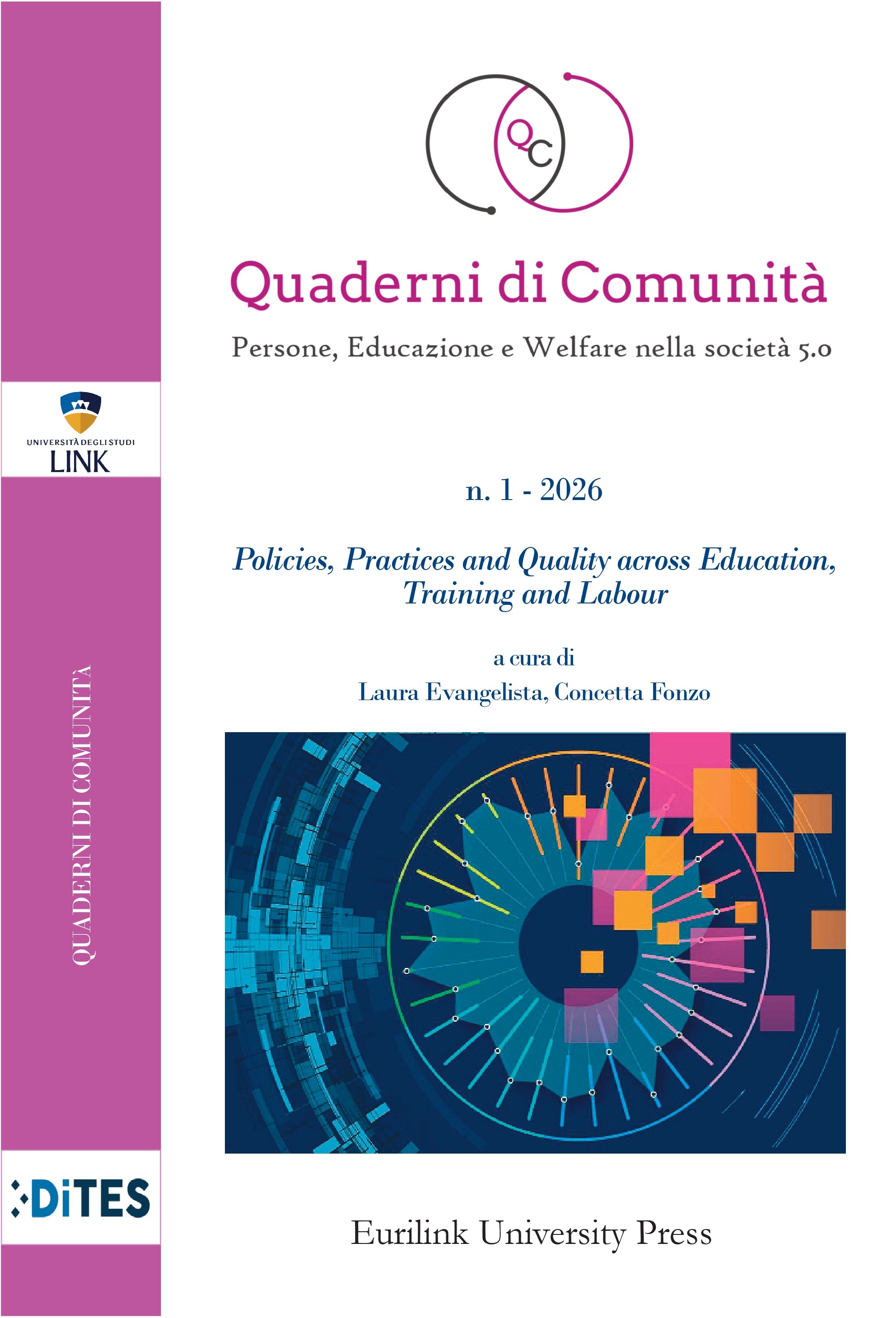
Edited by Laura Eevangelista and Concetta Fonzo

In recent years, education, training and employment systems have undergone profound transformations, driven by the acceleration of digitalisation processes, the growing integration of policies at European and international level, and the emergence of new skills requirements in the workplace and society. In this context, quality takes on a central role, no longer limited to the measurement of outcomes, but extended to the coherence between objectives, content, methodologies and tools, as well as the ability to enhance the value of different learning contexts—formal, non-formal and informal—within an integrated and dynamic framework.

The current debate highlights how quality can serve as a guiding principle to steer innovation, support lifelong learning and strengthen the link between training, work and social development, fostering dialogue between theoretical approaches and empirical evidence. Within this framework, the importance of involving stakeholders in decision-making processes and quality assurance mechanisms becomes clear, helping to make educational policies more effective and legitimate. At the same time, transformations in the productive sectors require greater alignment between education systems, businesses and local areas, promoting work-based learning models and continuous training pathways capable of supporting digital and ecological transitions.

Technological innovations, particularly artificial intelligence, pose new ethical, pedagogical and social challenges, requiring an anthropocentric approach that maintains the centrality of the individual, promotes inclusion and ensures the responsible use of technologies. At the same time, the evolution of public policies highlights the need for multi-level governance systems capable of coordinating institutional and regional actors, whilst models for evaluating vocational training are moving towards a focus on continuous improvement. However, critical issues remain regarding regulatory fragmentation and the difficulties in recognising skills in transnational contexts, making it necessary to strengthen shared tools and common standards.

In this context, the processes of skills validation and certification take on particular importance, including through digital tools, which enable the recognition of learning acquired in non-formal contexts and the promotion of flexible pathways throughout the lifespan. Digital transformation also impacts organisational models, training practices and assessment processes, encouraging the use of data for more informed decisions and improvement strategies.

Overall, these dynamics highlight the need for a systemic rethinking of the relationships between education, work and society, adopting approaches capable of integrating innovation, inclusion and continuous learning. Quality and quality assurance are therefore dynamic and relational dimensions, geared towards creating value for individuals and communities, and play a strategic role in guiding equitable, sustainable and future-oriented development processes.

Published: 2026-07-06

Editorial

Education Column

  • The Involvement of Student Associations in Quality Assurance Mechanisms of Educational Reforms in Italy

    Astrid Favella, Emiliane Rubat du Mérac
    23-31
    DOI: https://doi.org/10.61007/QdC.2026.1.411
  • Emerging competencies in oenology: quality and consistency in education and training programmes

    Paolo Brogioni
    33-41
    DOI: https://doi.org/10.61007/QdC.2026.1.402

Empowerment Column

  • Artificial Intelligence: an anthropocentric, ethical and inclusive approach

    Alessandro Barca, Mariella Tripaldi
    45-54
    DOI: https://doi.org/10.61007/QdC.2026.1.408

Essays

  • Towards a high-quality apprenticeship system: European standards, decent work and multi-level governance. The case of the Tuscany Region

    Miriana Bucalossi
    57-83
    DOI: https://doi.org/10.61007/QdC.2026.1.400
  • Assessing the quality of vocational education and training in Italy: empirical evidence and policy implications of the EQAVET framework

    Massimiliano Mazzanti, Nicolò Barbieri, Alessandro Montanaro, Laura Evangelista, Concetta Fonzo
    85-114
    DOI: https://doi.org/10.61007/QdC.2026.1.412
  • Regulatory Fragmentation and Quality in Training: The Case of the Mediterranean Yachting Sector

    Fabio Croci
    115-141
    DOI: https://doi.org/10.61007/QdC.2026.1.404
  • Digital validation of skills in non-formal learning in Europe

    Giuseppe Palomba, Enrico Elefante
    143-169
    DOI: https://doi.org/10.61007/QdC.2026.1.406
  • The Evolution of Microcredentials within Italy’s Continuing Vocational Training System: Regulatory Advances and Social Implications

    Alessandra Pedone
    171-201
    DOI: https://doi.org/10.61007/QdC.2026.1.399
  • Digital Transformation: Processes, Organisational Models and Osh Training

    Sara Stabile, Rosina Bentivenga, Emma Pietrafesa, Edvige Sorrentino, Margherita Bernabei, Silvia Colabianchi, Francesco Costantino
    203-238
    DOI: https://doi.org/10.61007/QdC.2026.1.388
  • The heuristic value of data, digital and AI literacy for school evaluation within the National Evaluation System

    Michela Freddano, Miriam Mariani
    239-276
    DOI: https://doi.org/10.61007/QdC.2026.1.410
  • The AI Turn in Higher Education: From Labour Market to Employment Challenges

    Danilo Boriati, Mariangela D'Ambrosio
    277-303
    DOI: https://doi.org/10.61007/QdC.2026.1.401
  • Rethinking Assessment with Artificial Intelligence: Quality, Equity and Pedagogical Sustainability in Higher Education

    Francesco Pio Sarcina, Michele Baldassarre
    305-336
    DOI: https://doi.org/10.61007/QdC.2026.1.407
  • Between digital transformation and relational capital: a sociological analysis of the university experience to rethink policies on the right to education

    Giuseppe Monteduro, Daria Panebianco, Sara Nanetti
    337-370
    DOI: https://doi.org/10.61007/QdC.2026.1.403
  • A human rights-based approach to social work training. The experience of the European project ‘Fundamental Rights in Daily Actions of Social Workers’ (FRIDAS) in the co-creation of participatory tools

    Cecilia De Baggis, Vittoria Grillo, Andrea Bilotti
    371-398
    DOI: https://doi.org/10.61007/QdC.2026.1.409
  • COIL in engineering Educational Activities: Challenges and Opportunities

    Nestor Mora Núñez, Juan Carlos Calabria Sarmiento
    399-425
    DOI: https://doi.org/10.61007/QdC.2026.1.405

In-Depth Analysis

  • Building the future. A transformative teaching model for careers guidance.

    Domenico Barricelli
    429-437
    DOI: https://doi.org/10.61007/QdC.2026.1.418